Aşırı Parlak Süpernovanın Gizemi Çözüldü: Salınan Manyetar Işığı Uzayı Aydınlatıyor.

Filtrele
Ece Müker
Bilim Haberleri
Aşırı Parlak Süpernovanın Gizemi Çözüldü: Salınan Manyetar Işığı Uzayı Aydınlatıyor.
Nature dergisinde yayımlanan yeni bir çalışma, astronomların uzun süredir açıklayamadığı "aşırı parlak süpernovalar" (SLSNe-I) olgusuna çarpıcı bir yanıt sunuyor. Bu süpernova türü, sıradan süpernovalara kıyasla en az 10 kat daha fazla ışık yayıyor; ancak bu muazzam enerjinin kaynağı bugüne kadar tartışmalıydı.
 
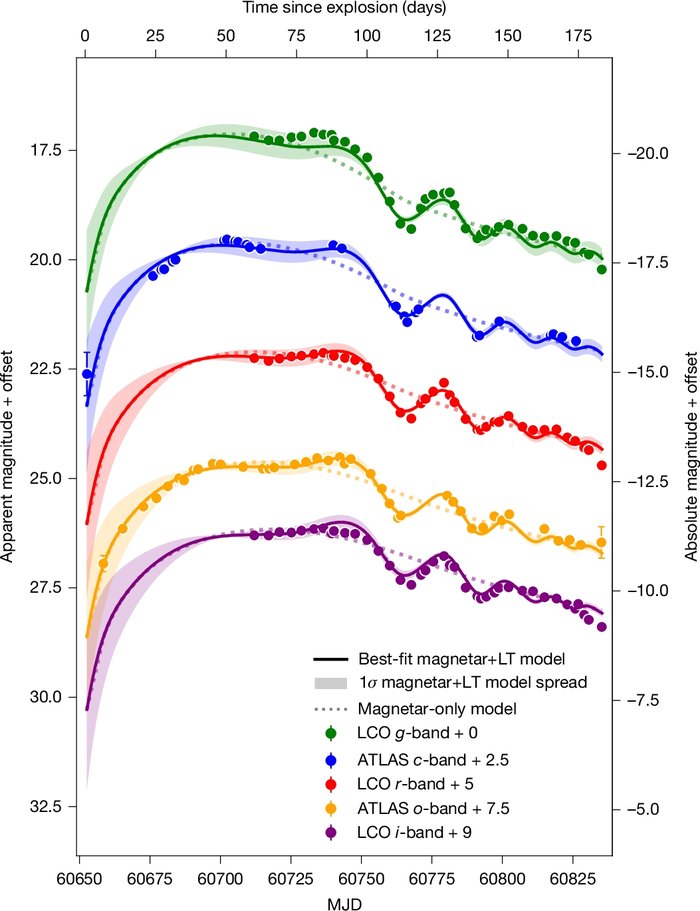
Las Cumbres Gözlemevi'nden Joseph Farah liderliğindeki ekip, SN 2024afav adlı süpernovayı gözlemlerken ışık eğrisinde giderek hızlanan düzenli dalgalanmalar (titreşimler) fark etti. Bu "chirped" (frekansı değişen) sinyal, standart manyetar modeliyle açıklanamıyordu.
 
Araştırmacılar, bu titreşimlerin kaynağının süpernovanın merkezinde yer alan hızla dönen bir manyetar (aşırı yoğun, güçlü manyetik alanlı nötron yıldızı) ve onun etrafındaki bir akış diski olduğunu keşfetti. Disk, manyetarın dönme eksenine göre eğik konumda dönerken Lense-Thirring sarsıntısı adı verilen bir etki nedeniyle sallanıyor; bu sarsıntı ise süpernovanın parlaklık eğrisindeki dalgalanmalar olarak gözlemlenebiliyor. Tıpkı eğik dönen bir topaç gibi.
 
Ekip bu modelden yola çıkarak manyetarın dönme periyodunu 4,2 milisaniye, manyetik alan şiddetini ise 1,6×10¹⁴ Gauss olarak bağımsız biçimde hesapladı; her iki yöntemden elde edilen sonuçlar birbirini doğruladı.
 
Bu bulgu iki açıdan tarihi: Hem aşırı parlak süpernovaların enerji kaynağını ilk kez somut kanıtlarla açıklıyor, hem de Lense-Thirring etkisinin bir manyetar ortamında gözlemlendiğini kanıtlayan ilk çalışma olma özelliği taşıyor. Araştırmacılar, bu yaklaşımın genel görelilik teorisini süpernova gibi şiddetli ortamlarda test etmek için yeni bir kapı araladığını vurguluyor.

317 görüntülenme

Evrim Ağacı bu gönderiyi öne çıkardı.
Lense–Thirring precessing magnetar engine drives a superluminous supernova
Nature
Lense–Thirring precessing magnetar engine drives a superluminous supernova
Type I superluminous supernovae (SLSNe-I) are at least an order of magnitude brighter than standard SNe, with the power source for their luminosity still unknown1–3. The central engines of SLSNe-I are suggested to be magnetars4,5 but most of the SLSNe-I light curves have several bumps that are unexplained by the standard magnetar model6–8. Existing explanations for the bumps either modulate the engine luminosity or invoke interactions with circumstellar material (CSM). Surveys of the limited sample of SLSN-I light curves find no compelling evidence favouring either scenario7,9, leaving both the nature of the light-curve fluctuations and the applicability of the magnetar model unresolved. Here we report high-cadence multiband observations of a SLSN-I with clear ‘chirped’ (that is, decreasing period) light-curve bumps that can be directly linked to the properties of the magnetar central engine. Our observations are consistent with a magnetar centrally located within the expanding supernova ejecta, surrounded by an infalling accretion disk undergoing Lense–Thirring precession. Our analysis demonstrates that the light curve and bump frequency independently and self-consistently constrain the magnetar spin period to P = 4.2 ± 0.2 ms and the magnetic-field strength to B = (1.6 ± 0.1) × 1014 G. These results provide the first observational evidence of the Lense–Thirring effect in the environment of a magnetar and confirm the magnetar spin-down model as an explanation for the extreme luminosity observed in SLSNe-I. We anticipate that this discovery will create avenues for testing general relativity in a new regime—the violent centres of young SNe. Observations of a nearby type I superluminous supernova showing oscillating light-curve bumps provide evidence of a centrally located magnetar in the wake of the explosion, surrounded by an infalling accretion disk undergoing Lense–Thirring precession.
4
Paylaş
Yorumlar yükleniyor...